
Pt100 Resistance Thermometers – Design, Function, and Applications

A Pt100 is a platinum resistance thermometer used to measure temperature.
At 0 °C, the platinum sensing
element has a nominal resistance of 100 Ω. As the temperature rises, the electrical resistance of the
sensing element changes. The temperature can be determined from the measured resistance.
This page explains the design, operating principle, characteristic curve, resistance values, accuracy,
connection types, and typical measurement errors of Pt100 resistance thermometers. A Pt100 calculator
and resistance tables are also available.
What does Pt100 mean?
- Pt = chemical symbol for platinum
- 100 = electrical resistance in ohms at 0 °C
How does a Pt100 work?
The sensor, which is installed in a protective housing, is often
referred to as a resistance thermometer (RTD = Resistance
Temperature Detector).
The defined temperature measurement range is -200 to +850 °C.
Depending on the design, it is often limited.
When the Pt100 resistance thermometer is subjected to a temperature change, the electrical
resistance of the platinum resistance element changes according to the temperature change.
As the temperature rises, the resistance of the platinum element increases.
The resistance characteristic curve of the Pt100 is approximately linear over a wide temperature range.
For accurate calculations, the standardized characteristic equations specified in DIN EN 60751 are used.
This property makes the Pt100 particularly suitable for precise and reproducible
temperature measurements.
The achievable measurement accuracy depends, among other things, on the accuracy class of the Pt100.
The Pt100 resistor is supplied with a constant current and the value of the voltage
drop generated by the change in resistance is converted into a temperature.
They are often used in industrial and laboratory equipment to measure temperature in processes and experiments.
There are also special Pt100 resistance thermometers designed for use in aerospace or medical applications.
The advantage of using a resistance thermometer is that there are no moving parts, making it very reliable.
However, it is important to calibrate the resistance thermometer regularly to ensure the accuracy of the
measurement.
Pt100 – Characteristic curve and resistance values
The characteristic curve of a Pt100 describes the relationship between temperature and electrical resistance.It is internationally standardized and enables precise temperature calculation DIN EN IEC 60751
.
Example values:
Pt100 calculator
The resistance of the Pt 100 at different temperatures can be calculated with the following calculator.Please enter a temperature value in °C and press the "calculate" button.
The right window then displays the resistance in ohms calculated for the Pt100 resistance sensor.
Pt100 – Resistance – Table generator
If you would like to create your own individual table of resistance values at different temperatures,please visit our website: Create resistance table
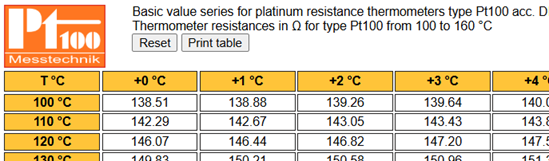
Download tables of the Pt100 resistance at different temperatures
 Download resistance table °C for Pt100 resistorsDownload resistance table °F for Pt100 resistors
Advantages of a Pt100-sensor:
- Linear resistance values and thus simple evaluation
- High accuracy and repeatability
- Long-term stability
- Interchangeability due to standardized resistance characteristic curve
Pt100 compared to Pt1000
In addition to Pt100 resistance thermometers (RTDs), Pt1000 sensors are increasingly being used.Both are based on platinum as the measuring element, but differ in their resistance at 0 °C and thus in important properties for various applications.
Difference between Pt100 and Pt1000
- Pt100: Resistance of 100 Ω at 0 °C
- Pt1000: Resistance of 1000 Ω at 0 °C
Advantages of Pt1000 over Pt100
- Lower cable influences
With Pt100, long connection cables can significantly distort the measured value, as even small resistances have a noticeable influence. With Pt1000, the same cable resistance is much less significant in relative terms. - Higher measurement accuracy in practice
Due to its reduced sensitivity to cable resistance, the Pt1000 delivers more reliable measurement results – especially with 2-wire circuits. - Cost advantage
In many applications, Pt1000 can be used to avoid complex 3- or 4-wire circuits. This saves on material and installation costs.
When is a Pt100 appropriate, and when is a Pt1000?
Whether a Pt100 or a Pt1000 is more suitable depends, among other things, on the measurement circuit, the cable length,
the transducer, and the accuracy and installation requirements.
For longer connection leads, the higher nominal resistance of the Pt1000 can reduce the relative influence of
the lead resistance.
All technical articles published on pt100.de with attribution were written or reviewed by Harald Peters himself.
Author of this article:
Harald Peters – Technical author for temperature measurement technology